
Sign up to receive quotes
What is Light Estimation? The boundary between the Real and the Virtual


When placing a virtual object into the real world through a camera, what determines whether users perceive it as believable is often not the resolution of the 3D model, but the lighting. So, what is Light Estimation, and why is it the key technology that defines the boundary between convincing AR and artificial-looking AR?
This article provides a comprehensive look at how Light Estimation works, its main techniques and classifications, and its practical applications in modern augmented reality (AR) systems.
What is Light Estimation
Light Estimation is the process by which an AR system analyzes the real-world environment through a camera to determine surrounding lighting conditions—including light intensity, direction, color temperature, and shadow distribution. These lighting parameters are then applied to virtual objects inserted into the scene, creating a more realistic and immersive augmented reality experience across applications such as architecture, retail, and automotive visualization.
The primary goal of Light Estimation is to ensure that virtual objects respond to real-world lighting in a natural and consistent manner, seamlessly blending with their surroundings.
Without Light Estimation, a 3D model placed in a dark room would remain unrealistically bright, or an object positioned under warm sunlight would appear illuminated with neutral lighting. Such inconsistencies immediately break the sense of presence and realism that AR experiences are designed to achieve.
Why is our brain so sensitive to light?
Over millions of years, the human eye and brain have evolved an extremely refined mechanism for perceiving real-world objects through light and shadows. Even the slightest mismatch in lighting direction or color between a virtual object and the real environment immediately triggers a state of cognitive dissonance in the brain.
You may not be able to pinpoint the technical flaw, but your intuition will instantly signal: “This object does not belong in this space!”
How does Light Estimation work?
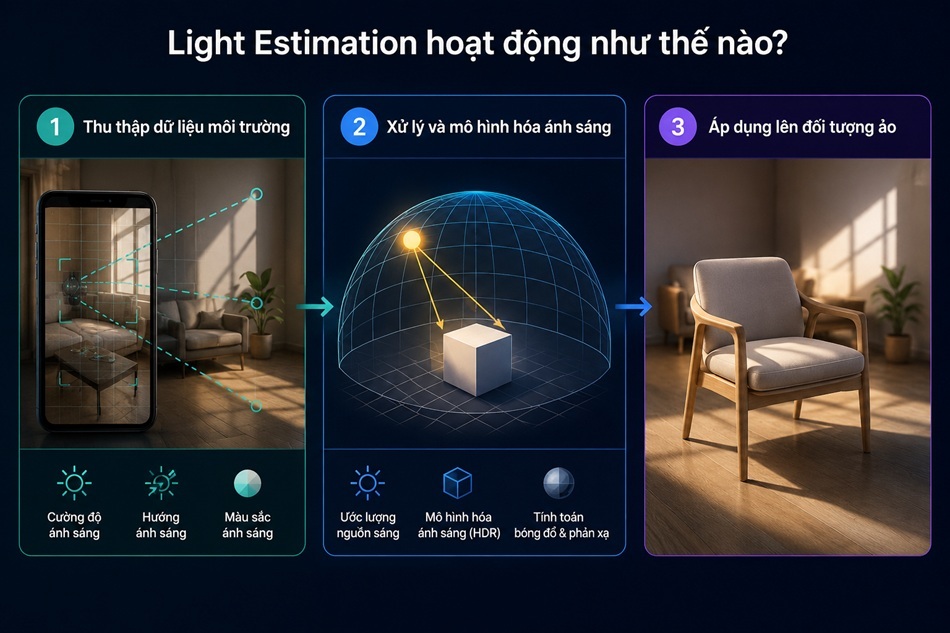
After the camera captures images, the Light Estimation system in AR goes through a complex mathematical processing workflow consisting of three steps:
Environmental data collection: The device’s camera continuously analyzes each frame to measure overall ambient intensity, color temperature (in Kelvin), and the spatial distribution of light.
Light processing and modeling: The collected data is processed using algorithms often based on Spherical Harmonics or Environmental HDR to generate a lighting map that represents the real-world environment at that moment.
Application to virtual objects: The lighting map is then passed into the 3D object’s shader, enabling its surface to respond to light, cast shadows, and produce specular reflections consistent with the real environment.
This entire process runs in real time and continuously updates as the user moves or lighting conditions change.
Why is Light Estimation important in AR?
An AR experience only delivers real value when users accept the presence of virtual objects within the real world. Light Estimation is the key technical factor that directly determines this level of acceptance.
Enhancing the credibility of AR content: Research in human perception within mixed reality environments shows that lighting inconsistency is the first factor that makes users perceive a virtual object as fake—before resolution or texture quality even matters.
Improving real-world application performance: In e-commerce, conversion rates for “AR try-on” features increase significantly when the lighting of virtual products matches the user’s room lighting, making the product appear more realistic.
Supporting decision-making: In interior design, architecture, and digital exhibitions, Light Estimation helps decision-makers more accurately visualize the real-world appearance of final products in terms of color and material.
Light Estimation is not merely an aesthetic feature—it is a technical foundation for trust in AR.
Common types of Light Estimation
In practice, light estimation technologies can be categorized into four levels, from basic to advanced. This classification is sometimes used to balance implementation cost in AR services.
Ambient Light Estimation: The most basic approach: it measures the average light intensity and color temperature of the entire environment. It is natively supported in a simplified form by ARKit (Apple) and ARCore (Google). This method is suitable for general AR applications that do not require high precision.
Directional Light Estimation: This method detects the direction and angle of the primary light source (usually sunlight or overhead lighting), enabling more accurate shadow casting for virtual objects. ARKit from version 2.0 onward supports this feature with fairly high accuracy.
Environmental HDR Lighting: This system generates a full 360° lighting map of the environment, allowing virtual objects to reflect and absorb light from all directions, including indirect light reflected from walls, floors, and surrounding surfaces. ARKit 3+ and the ARCore Depth API support Environmental HDR with results that closely resemble real-world lighting.
Neural/AI-based Light Estimation: This approach uses neural networks and deep learning models to predict light sources that are outside the camera’s field of view. For example, even if the camera is only pointed at the floor, AI can infer—based on real-world shadow patterns such as those from table legs—that there are three fluorescent ceiling lights turned on above. This technique estimates lighting conditions from contextual visual cues, even when light sources are not directly visible. Research from Meta Reality Labs and Google AR is actively advancing this direction to handle complex real-world lighting scenarios.
Practical applications of Light Estimation
Digital museums and virtual exhibitions: 3D artifacts or artworks displayed in AR environments must respond accurately to the lighting conditions of the real exhibition space. This is especially important when museums deploy on-site AR experiences for visitors.
E-commerce and AR product try-on: Brands in furniture (such as IKEA Place), fashion, and cosmetics use Light Estimation to ensure that virtual products display accurate colors and materials within each customer’s environment, reducing return rates and increasing purchase confidence.
Architecture and spatial design: Clients can visualize furniture, wall finishes, or design concepts directly within their real space through AR. Light Estimation ensures that paint colors, wood textures, or metallic materials are rendered accurately under the room’s actual lighting conditions.
📍 You may also be interested in: A list of the world’s most successful AR campaigns
Light Estimation is the technical foundation that determines the persuasiveness and real-world effectiveness of all AR applications—from digital museums and e-commerce to spatial design. When virtual and real lighting align correctly, the boundary between the digital and physical worlds gradually fades in the most literal sense.


Articles on the same topic

Các Virtual tour của VR360 đáp ứng tiêu chuẩn WCAG 2.2 A, AA, AAA như thế nào?
 04/09/2026
Tiêu chuẩn WCAG là gì? Tìm hiểu các phiên bản và mức độ AA, AAA
03/09/2026 
Case study: Bản đồ số du lịch thông minh TP. Đà Nẵng
24/08/2026 
25+ Tính năng nổi bật trong bản đồ số du lịch Đà Nẵng
13/08/2026 
Bản đồ số du lịch Đà Nẵng: Góc nhìn từ công tác quản lý
06/08/2026 
Bản đồ số địa chỉ đỏ Hà Nội sau 2 năm nhìn lại: Những con số biết nói
20/07/2026 
Góc nhìn: Quy chế chuyển đổi số xã phường hiện nay
14/07/2026 
Plane Detection: Công nghệ nhận diện mặt phẳng trong AR
29/06/2026 Typical customers































































Sign up to receive information from VR360
Business License Registration Address: 63 Phan Dang Luu, Hoa Cuong Nam Ward, Hai Chau District, Da Nang City, Vietnam