
Sign up to receive quotes
What Is Cinematic VR? The Future of Immersive Storytelling


The content industry is facing a familiar challenge: audiences are becoming increasingly passive, viewer retention rates are declining, and brand messages struggle to leave a lasting impression.
Cinematic VR (CVR) has emerged as a new approach—not simply allowing audiences to watch a story unfold, but placing them at the very center of it. This article explores what Cinematic VR is, how it works, and why it is widely regarded as the future of immersive storytelling.
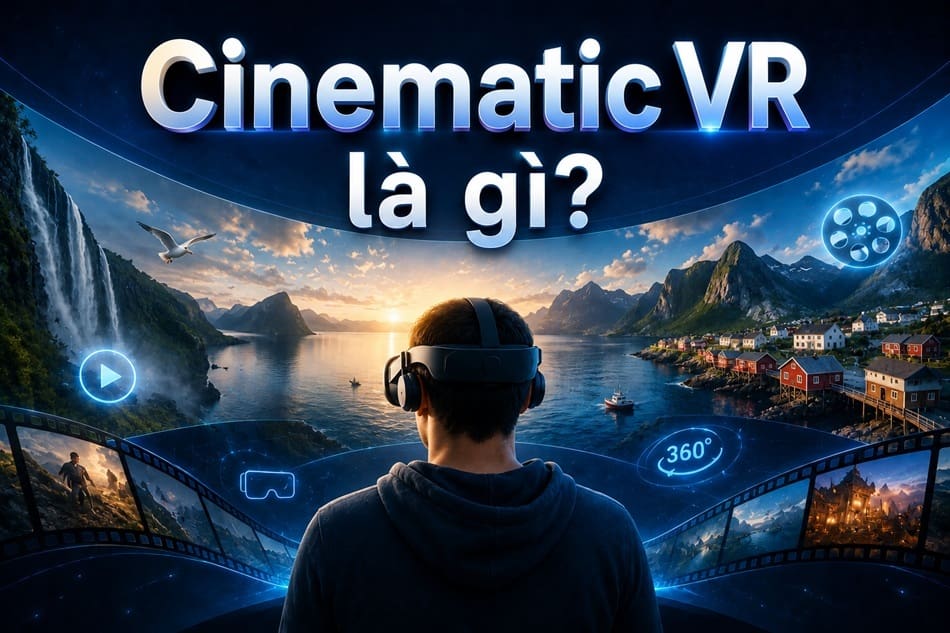
1. What is Cinematic VR?
Cinematic VR (CVR) is an immersive storytelling format that allows viewers to explore a scene in full 360 degrees while experiencing specially designed spatial audio, creating a powerful sense of presence. Rather than simply watching content on a traditional two-dimensional screen, viewers feel as though they are physically immersed in the virtual environment.
What sets Cinematic VR apart is its approach to content creation. Unlike traditional VR experiences that rely on computer-generated characters and environments, CVR uses real-world footage captured with specialized cameras, making it far closer to filmmaking than gaming. The production process incorporates cinematic techniques such as scripted storytelling, professional acting, lighting design, shot composition, lens selection, and color grading.
Positioned at the intersection of storytelling and technology, Cinematic VR creates a unique medium that enables audiences to experience narratives from within the story itself, delivering a deeper level of immersion and emotional engagement.
2. How does Cinematic VR work?
Cinematic VR (CVR) represents a significant evolution in filmmaking, leveraging virtual reality technology to create deeply immersive storytelling experiences. Unlike traditional films, where viewers observe the story from a fixed perspective, Cinematic VR places audiences at the center of the narrative environment. Viewers are free to control their field of view, while directors employ creative techniques to subtly guide attention and maintain narrative focus. The format encompasses a wide range of approaches, from purely linear storytelling to more sophisticated experiences featuring branching narratives or limited interactive elements.
The production process of a Cinematic VR project typically consists of three key stages:
360° Content Capture
Specialized cameras—typically multi-lens rigs or high-resolution 360° cameras—capture the entire environment from every angle. Modern VR headsets now offer display resolutions comparable to, or even exceeding, 4K screens, significantly reducing the “screen-door effect” that once limited the visual quality of early-generation VR experiences.
Content Processing and Post-Production
Captured 360° footage undergoes stitching, color correction, spatial audio design, and, when required, the integration of interactive elements. This stage plays a critical role in determining the viewer’s sense of presence and immersion within the virtual environment.
Delivery Through Head-Mounted Displays (HMDs)
Users experience the content through Head-Mounted Displays (HMDs), which place them directly at the center of the scene and allow them to freely determine their viewing direction throughout the experience.
To effectively guide audience attention within a fully immersive environment, filmmakers rely on traditional cinematic principles such as composition, visual continuity, lighting, movement, and sound cues. These techniques help virtual environment designers direct the viewer’s focus naturally as they explore the surrounding space. Key Differences Between Cinematic VR and Traditional Video
3. Key differences between Cinematic VR and Video 2D
| CRITERIA | VIDEO 2D | CINEMATIC VR |
| Viewing Perspective | Fixed camera viewpoint | Full 360° freedom of view |
| Viewer PositionObserves the story from the outside | Observes the story from the outside | Placed at the center of the story |
| Interaction | Passive viewing experience | Active participation through head movement |
| Audio Experience | Standard 2D stereo audio | Spatial audio that responds to the viewer’s |
| Viewing Device | Flat-screen devices such as TVs, monitors, and smartphones | VR headsets (HMDs) |
4. Benefits of Cinematic VR
Enhanced Sense of Presence and Emotional Engagement
Research published in the journal Virtual Reality (Springer) confirms that VR films generate higher levels of immersion and emotional engagement compared to their 2D counterparts, highlighting the potential of Cinematic VR to influence audiences beyond the boundaries of traditional cinema.
More Effective Brand Storytelling
Cinematic VR creates a 360° visual experience that places viewers in a first-person perspective as they follow a narrative. This unique ability to position audiences inside the story is a distinct advantage that no other content format can fully replicate.
Applications in Training and Education
Cinematic VR combines 360° video with cinematic storytelling techniques to create highly engaging learning experiences. The format has already been validated across various training scenarios, including healthcare education, crisis management, and workplace simulation programs.
Reduced Costs for Accessing Real-World Environments
Immersive VR experiences can serve as a cost-effective and environmentally friendly alternative to physical site visits. At the same time, they enable learners and participants to closely examine objects, environments, and situations in ways that may not always be practical or possible in the real world.
5. Applications of Cinematic VR
Film and Entertainment
Cinematic VR enables filmmakers to create deeply immersive experiences where audiences feel physically present within the story's environment. Viewers can stand in the middle of a historical battle, explore a fantasy world, or accompany characters throughout their journey, creating a stronger emotional connection than traditional film formats can achieve.
Museums and Cultural Heritage
AR and VR technologies are transforming museums by bringing exhibits to life and reconstructing historical sites around visitors. Cinematic VR takes this concept further by placing audiences directly inside historical settings, allowing them not only to observe history but to experience and feel it.
Tourism and Destination Marketing
Virtual reality has demonstrated value across multiple sectors, including education, tourism, entertainment, heritage preservation, safety training, and business. In tourism, Cinematic VR allows potential travelers to preview destinations before booking, increasing conversion rates while setting realistic expectations for the experience.
Events and Brand Communications
Product launches, trade exhibitions, and public relations campaigns increasingly leverage Cinematic VR to create memorable brand experiences that leave a longer-lasting impression than conventional video content. As Extended Reality (XR) technologies continue to evolve, they are transforming the way audiences consume digital content through unprecedented levels of immersion and engagement.
Corporate Training
By simulating real-world scenarios such as interviews, crisis management situations, and product presentations, Cinematic VR helps organizations shorten training cycles while improving knowledge retention compared to traditional text-based materials or 2D video content.
Cinematic VR is not intended to replace traditional video. Instead, it fills a gap that flat-screen media cannot address—the ability to create a genuine sense of presence within digital environments.
For organizations seeking to digitize physical spaces, elevate brand storytelling, or deliver more engaging user experiences, now is the ideal time to explore the value that Cinematic VR can bring to your digital transformation journey.
Contact VR360 today to discover the Cinematic VR solution best suited to your organization's needs.
Nguồn tham khảo:
Wikipedia – Cinematic Virtual Reality
ACM Digital Library – Embodied VR Cinema (2024)
MIT Press PRESENCE Journal – Mapping the Viewer Experience in CVR (2023)
Springer Virtual Reality – Evaluating the viewer experience of interactive VR movies (2023)
PMC / NCBI – Perspectives of 360-Degree Cinematic VR in Health Care (2022)
ScienceDaily – University of Helsinki VR cinematography study (2024)


Articles on the same topic

Các Virtual tour của VR360 đáp ứng tiêu chuẩn WCAG 2.2 A, AA, AAA như thế nào?
 04/09/2026
Tiêu chuẩn WCAG là gì? Tìm hiểu các phiên bản và mức độ AA, AAA
03/09/2026 
Case study: Bản đồ số du lịch thông minh TP. Đà Nẵng
24/08/2026 
25+ Tính năng nổi bật trong bản đồ số du lịch Đà Nẵng
13/08/2026 
Bản đồ số du lịch Đà Nẵng: Góc nhìn từ công tác quản lý
06/08/2026 
Bản đồ số địa chỉ đỏ Hà Nội sau 2 năm nhìn lại: Những con số biết nói
20/07/2026 
Góc nhìn: Quy chế chuyển đổi số xã phường hiện nay
14/07/2026 
Plane Detection: Công nghệ nhận diện mặt phẳng trong AR
29/06/2026 Typical customers































































Sign up to receive information from VR360
Business License Registration Address: 63 Phan Dang Luu, Hoa Cuong Nam Ward, Hai Chau District, Da Nang City, Vietnam